You cannot miss this: Genius! The famous Marble Machine expertly performed and recorded. Continue to his channel to see more.
Friday, September 22, 2017


Schlieren Photography
Yep! We did it again! We wrapped up another Sound Waves summer camp session and had a great kickoff to the new school year.
Here is the message I sent to parents after session 1:
"Thanks for sending your kid(s) to camp this week! I felt so much great energy from these kids. We did the coolest science today! I heard kids saying it was the most amazing thing they had ever seen. I admit I was pretty floored myself. We refracted light with a telescope mirror so that we could see things that were otherwise invisible, like heat, cold, breath, handclaps, butane vapors... it was awesome! If I can figure out super slow-mo photography I'll be able to catch sound wave vibrations but as it was we were pretty astounded. Kids acted like we had discovered light for the first time. We worked hard on the setup. It was very very hard to do as the angles and focal lengths and the precision has to be perfect for it to work. It was also very hard not to bump the table because it was so precise that the SLIGHTEST change to angles really messed it up. I had Kurt Glaser, a sound engineer coming who promised to help if I got stuck, but I got up at 5:30 to do all my housework so I could try to get it setup before the kids came or at least before the engineer came. I was working on it at 7:15 AM, and when the kids came at 9:00 I still wasn't done. But I was lucky I had them: They brought all their problem solving heads together and at 9:45 when the sound engineer came in we were all yelling "coooooooll!!," at the images we were recording on the camera, and he didn't get a lot of attention when he walked in!! But he's exactly like us. Crazy about science. He came over to what we were looking at and started joining in with coooooool!!
Then we had a lecture on microphones and cables and a test on the materials presented, (think transducers, high M, low M, 96/24bpp, vs. 48/16bpp) then he taught us about record setup and showed the kids how to record in real life. He connected very well with the kids.
"After that, the poor starving children ate lunch then we made covered boxes, (think colored tissue paper, note stickers, music paper, tons of glue being applied with bristle brushes and everybody asking each other for one of the four pairs of scissors... next time I need 20 pairs) then we went through the fascinating process of making french bread (think awe-inspring monstrously-swelling dough threatening to overtake the mixing utensil left in the bowl during the resting period and a very cloudy-looking kneading party,) which may have been the messiest the kitchen has ever been... sigh! But when most of the loaves were safely in the oven, I put them all to work and they faithfully cleaned up quite a bit of our giant, floury janitorial catastrophe. Anyway, the house smelled wonderful even though it was terrible to look at. 😄hope you enjoyed the bread and don't wait to save it because it won't be so good tomorrow. Remember honey and butter! Though we tackled some big projects today we even got a couple rounds of our two rhythm games AND some quality round robin ping pong!
Ok, I know they are waaay more high tech than we were, but they could not be having more fun than we did.
Please show your kid this video so they can see more about how schlieren flow visualization can be."
Session two included a lot of food from Europe! We made French Crepes, Norwegian Lefse, German potato soup, and REAL BELGIAN WAFFLES. I searched and found a recipe and it looked authentic. I took a bite and memories of Belgium and walking the shopping streets and stopping for "luikse wafels" flooded through me. It was authentic, all right. My daughter put one in her mouth and her eyes popped wide open. "I'm there!" she exclaimed, and ran for the phone to call her dad and tell him we'd pulled it off. Don't let making pearled sugar put you off: I was way more causal and less refined about how even that was done, and it turned out fine.
Session two also included a hand shadow play called "The Bunny Wedding" which I did not videorecord and post for you, because I was either playing the piano for it, or I was laughing too hard. This generally younger set of kids did very well in their final presentation for the parents. The play was mostly written by kids, produced by kids, tickets printed by kids, audience welcomed by kids, extra scenery cut out by kids... We also got a chance to admire the pros! You need to see this amazing video!
In both camps we drilled rhythms for hours... and hours.... and hours!
We also kept illustrated journals and had recording engineer sessions, and a pipe organ field trip at Faith Lutheran Church in Redmond, and two recitals at Peters Creek Retirement! It was a very busy and productive time!
I will need to set next year's dates very early: I have inquiries already about joining next year.
Wednesday, December 7, 2016
Don't miss hearing this
Teddy Emanuel is very, very good at describing layers of music! He may not know how to read music, but music is in him, nonetheless. You see, reading music is as useful to performing as reading books is to storytelling or learning a language. It is very helpful, but you can actually learn more in some cases by simply surrounding yourself with music.
Sunday, December 4, 2016
The Rhythm Game
Here is a Group of Music Camp students participating in the Rhythm Game! Game rules are written out below.
This group game teaches rhythm skills, sight reading and mental focus in a fun and competitive way! Here is how to implement it in your own studio or music camp: The players are seated around a circle of cards upon which are written rhythms of a similar meter. The seating are ranked: seat number 1 is the best spot to be in and is called the Starter's seat (because that one starts each new round) and to his left, 2 (next in line to be the Starter) and on down around the circle to "the bottom of the totem pole," the person who sits directly to the right of the Starter.
The Starter and starts by counting and clapping his own rhythm then any other player's rhythm. That player must then count and clap his own rhythm without missing a beat then counts and claps another person's rhythm of his choice. And so on.
If anyone misses a count or a rhythm, he goes to the bottom of the totem pole and the ones below his former spot move up to fill the empty space.
The point of the game is to maintain your spot in the starter's chair for five turns straight, after which everyone moves to the right one chair in order to allow for a fresh rotation. This way no advanced players are allowed to permanently dominate the game to the disadvantage of younger players. Teachers make good referees as well as participants. (It's particularly hilarious if the teacher spaces out...) Metronomes make good standards and tempo setters. Before actually playing the first round, it's good for the teacher to demonstrate each rhythm around the circle, then have each student demonstrate their knowledge of each rhythm.
Don't be surprised if at first students struggle keeping the beat during the game: it's a lot to manage at first so give them a comfortable tempo and lots of warm up time. After a while they get more comfortable and can police themselves like the students in the video. The game is a variation of "fruit basket," another call-and-response circle game
The Starter and starts by counting and clapping his own rhythm then any other player's rhythm. That player must then count and clap his own rhythm without missing a beat then counts and claps another person's rhythm of his choice. And so on.
If anyone misses a count or a rhythm, he goes to the bottom of the totem pole and the ones below his former spot move up to fill the empty space.
The point of the game is to maintain your spot in the starter's chair for five turns straight, after which everyone moves to the right one chair in order to allow for a fresh rotation. This way no advanced players are allowed to permanently dominate the game to the disadvantage of younger players. Teachers make good referees as well as participants. (It's particularly hilarious if the teacher spaces out...) Metronomes make good standards and tempo setters. Before actually playing the first round, it's good for the teacher to demonstrate each rhythm around the circle, then have each student demonstrate their knowledge of each rhythm.
Don't be surprised if at first students struggle keeping the beat during the game: it's a lot to manage at first so give them a comfortable tempo and lots of warm up time. After a while they get more comfortable and can police themselves like the students in the video. The game is a variation of "fruit basket," another call-and-response circle game
Links to 15 national anthems
Here are working links to some national anthems from countries around the world. I have enjoyed these and hope you do too. I trust I am not being unpatriotic when I say I think my all-time favorite is "Deşteaptă-te Române" - the Romanian National Anthem. What a stirring melody! I love the American National Anthem too, but the Romanian Anthem's minor key is really fantastic.
India
China
England
America
Croatia
Belgium
Thailand
Spain
Romania
Vietnam
Sri Lanka
Canada
Scotland
Germany
Mexico
Monday, October 20, 2014
Here are some Studio photos from our Asian and Russian Concert (programs and Program notes included) These students really made a special musical evening!
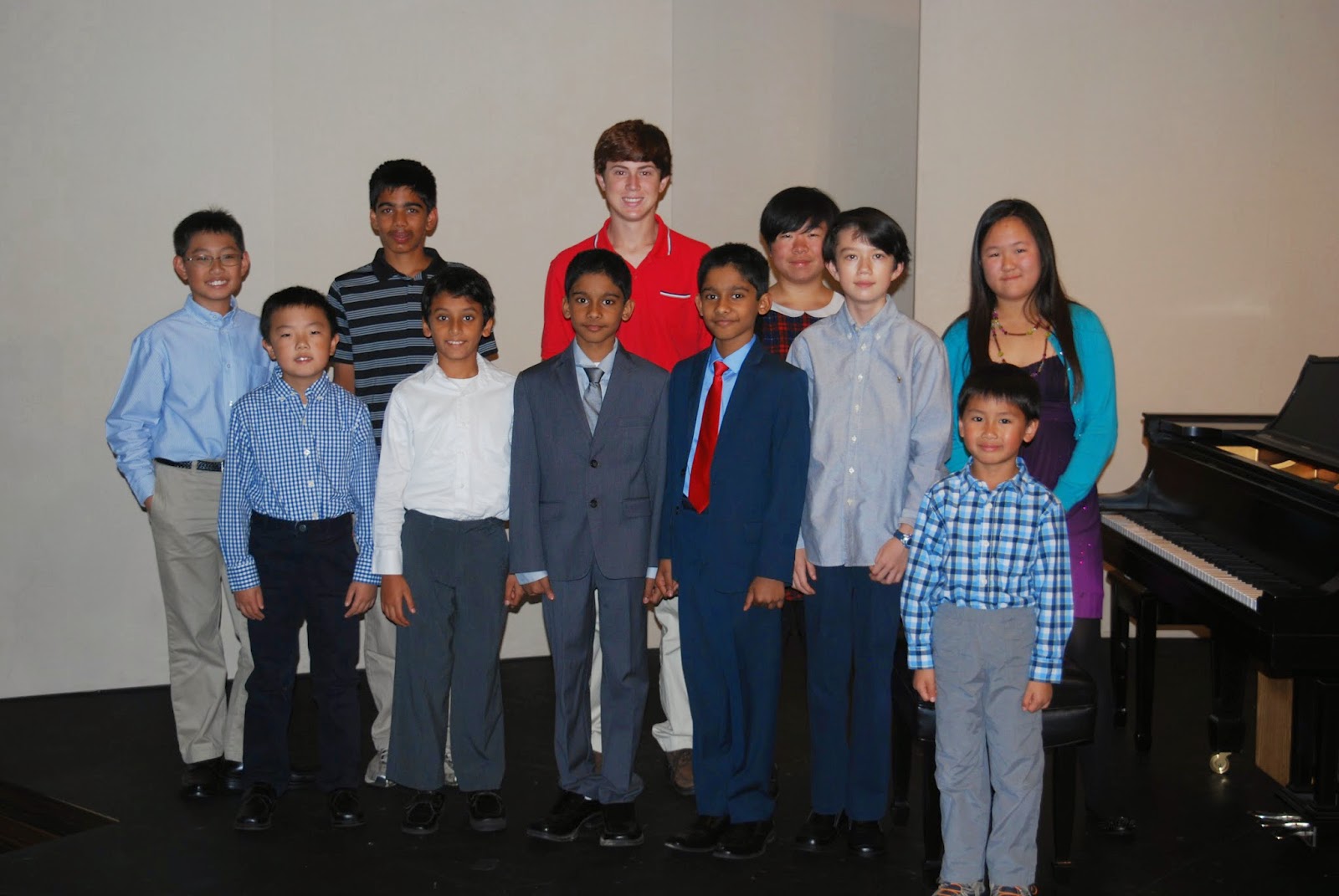


SATURDAY SEPTEMBER 27, 2014 at Stage 7 Pianos of Kirkland 6:00 PM
A Russian and Asian Music Recital given by
students of Bonnie Debu
Satyen Subramaniam, 11 Etude in A minor Op. 27 No. 3
–Dmitri Kabalevsky (Russia)
Matthew Ng, 6 (duet with Daniel Ng) Swan Lake –
Tchaikovsky (Russian)
Aadi Agrawal, 9 Chinese Kites – (Gem
Fitch)
Jab Koi Bat – Rajesh Rohan (India)
Sriya Pratipati, 9 Chura Liya – (India)
Sriya and Sowmya, Trepak from the Nutcracker Suite by Tchaikovsky
(Russia)
Suriyen Subramaniam, 11 Chatushka No. 89 no. 25 (Russia)
The Russian Chatushka is a poem with
a sometimes satirical or political twist
Andy Ye, 8 Competing Horses (China) This authentic melody from China truly
describes the energy of athletic horses!
Kamarinskaya –
Tchaikovsky (Russia) The Kamarinskaya is
a Russian Traditional Folk Dance
Daniel Qian, 8 Tibetan Plateau (Korean Author) In this beautiful tone poem which is
originally a song, you can hear the great expanse of the high plains of Tibet.
It is easy to imagine the thin air and the cold wind blowing the grasses and
the manes and tails of the grazing horses.
Aditya Balasubramaniam,
13 After the Ball –
Alexander Grechaninov (Russian)
Song of Twilight – Yoshinao Nakada (Japan)
Emily Zhao, 12 Cowherd’s Flute – (China)
Sowmya Pratipati, 12 Pehla Nasha – (Indian cimematic
theme song)
Andrew Hall, 15 Waltz of the Flowers from the Nutcracker Suite – Tchaikovsky
(Russia)
An Ancient Tale – Bohdana
Filtz (Ukraine)
Aidan Lawler, 11 Mandarin Orange (in the Chinese
style) – C. Michael Erhardt
Rebecca Zhou, 15 “Harp” Prelude Op. 12 No. 7 –
Prokofiev (Russia) This beautiful piano
solo is often performed on the harp. Prokofiev’s music often contains sarcastic
and bitter harmonies, which can be heard briefly in the angular and rhythmic
middle section of this Prelude, but the first and last themes are refreshingly
harmonic and light.
Daniel Ng, 12 Rush Hour in Hong Kong – Abram Chasins
This hilarious piece is by a Jewish
composer living in New York who admitted his qualifications to compose in this
style are limited, as he has never even set foot in the orient, but the clever
imagery of super busy street traffic in an imagined Chinese style is enough to
warrant its placement in this program! The piece was tremendously popular in
the earlier half of the 1900’s and was performed in concert by the great
pianists of the day including Rachmaninoff and Moiseiwitsch and is enjoying a
comeback in our day.
Please feel free to stay for the
second recital which is also open to the public, (7:00-7:45 PM), after which we
will have a short reception. If you have to go, please snag a cookie by the
door on your way out!
Postcard
From the East
SATURDAY SEPTEMBER 27, 2014 at Stage 7 Pianos of Kirkland, WA
A Russian and Asian Music Recital
given by students of Bonnie Debu 7:00 PM
Raymond Guo, 11
Qingjiang River (China)
Pranati Dani, 11 Sun
raha hai na tu (India)
Melissa
Lin, 11 Dark Sky (Folk Melody from Taiwan) A Winter Melody - Yoshinao
Nakada (Japan)
Dhruv Srinivasan,
10 Song of the Cavalry and Toccatina – Dmitri Kabalevsky (Russia)
Amber Debu, 8
Prelude in D flat Major - Gliere (Russia)
Ashwin Chintalapati, 9
Bagatelle - Tcherepnin The author
was Russian, married to a fine Chinese pianist and was very influenced by
Chinese music
Chloe
Wu, 9 "Silver Clouds Chasing the Moon" (China) This mysterious piece is a favorite melody in
China and is performed by the preeminently popular pianist in China: Lang Lang
Siri Mellem, 15
Concerto No. 2, Mvt. 2 Andanto
Sostenuto, Sergei Rachmaninoff (Russia)
Full of wistful longing, this middle
movement of the famous second piano concerto unfolds into a longing melody that
is exchanged between the piano and the orchestra. It is typical of the very
long lines and multilayered textures of Russian music.
Dan Ho,
Prelude Op. 32 No. 10 in B minor – Rachmaninoff
(Russia) This was Rachmaninoff’s own
favorite Prelude, full of a dark sadness, a desolate landscape. It fills out in
the middle section into tremendously rich and sonorous chords. The incredibly
thick texture and long lines is typical of Russian composition.
Moment Musicale No. 4 in E minor – Rachmaninoff
“I want to especially express
my appreciation to each of my students who has worked so hard to prepare for
this evening of music! I have so enjoyed hearing this music developing in the
studio this past summer, and learning new things with you!” -Bonnie Debu, NCTM
Baroque and Classical Unit Study Links Guide
Hilary Hahn Bach Concert Promo Video
Bach documentary 1
Bach Documentary 2
Bach Documentary 3
Bach Documentary 4
Bach Documentary 5
Bach Documentary 6 - how Bach worked
Bach Documentary 7 - Choral
Bach Documentary 8 later life
The Genius of Bach
Cartoon of Toccata and Fugue
Animation of a Fugue
Flower Animation of Prelude in C
Very Very Clever Happy Birthday in the style of various composers- cracks me up!
Classic Period
Martha Washington's gingerbread cake
Probably a more authentic version of the same
Austen Period Dancing in a Ballroom
Gregorian Period Cooking
Bach documentary 1
Bach Documentary 2
Bach Documentary 3
Bach Documentary 4
Bach Documentary 5
Bach Documentary 6 - how Bach worked
Bach Documentary 7 - Choral
Bach Documentary 8 later life
The Genius of Bach
Cartoon of Toccata and Fugue
Animation of a Fugue
Flower Animation of Prelude in C
Very Very Clever Happy Birthday in the style of various composers- cracks me up!
Classic Period
Martha Washington's gingerbread cake
Probably a more authentic version of the same
Austen Period Dancing in a Ballroom
Gregorian Period Cooking
Friday, August 16, 2013
Medieval and Renaissance Period Unit Study Links Guide
Music, Instruments and Dance
Medieval Music with Beautiful Pictures
Neo-Gregorian Chant with a Modern take- very, very beautiful!
Celtic Medieval Music, synthesized - static picture, 4 minutes
King Arthur's Court, a few beautiful pictures
Hilarious Pirate Style Medieval Sailor Singing in French, 5 minutes
Medieval Fiddle
Medieval Street Dancing, very Pretty!
Virelai Music
Pirate Tavern Music-Modal 7 minutes
Beautiful Costume Dance Montage 2 minutes
Rare Medieval Instruments- very strange but well played
Palestrina Choral, 9 minutes
Palestrina Motet Over and Hour of Singing...
Renaissance Guitar over an hour
Renaissance Dance
Architecture, Art, Living
Norman Castle
Castle Building 1 Awesome narrator
Castle Building 2
Castle Building 3
Leaning Tower of Pisa
Towns
Ever After Movie- costume
Ever After Movie- Leonardo Da Vinci and Redemption of a Servant
Ever After Movie- Conclusion, court scene, laundry room scene
Treasures
Elizabeth 1 Part 1
Elizabeth 1 Part 2
Coloring Pages
More Coloring Pages
Renaissance Coloring Pages
Chicken recipe
White Leek Sauce
Medieval Mind
Jewelry
Medieval Music with Beautiful Pictures
Neo-Gregorian Chant with a Modern take- very, very beautiful!
Celtic Medieval Music, synthesized - static picture, 4 minutes
King Arthur's Court, a few beautiful pictures
Hilarious Pirate Style Medieval Sailor Singing in French, 5 minutes
Medieval Fiddle
Medieval Street Dancing, very Pretty!
Virelai Music
Pirate Tavern Music-Modal 7 minutes
Beautiful Costume Dance Montage 2 minutes
Rare Medieval Instruments- very strange but well played
Palestrina Choral, 9 minutes
Palestrina Motet Over and Hour of Singing...
Renaissance Guitar over an hour
Renaissance Dance
Architecture, Art, Living
Norman Castle
Castle Building 1 Awesome narrator
Castle Building 2
Castle Building 3
Leaning Tower of Pisa
Towns
Ever After Movie- costume
Ever After Movie- Leonardo Da Vinci and Redemption of a Servant
Ever After Movie- Conclusion, court scene, laundry room scene
Treasures
Elizabeth 1 Part 1
Elizabeth 1 Part 2
Coloring Pages
More Coloring Pages
Renaissance Coloring Pages
Chicken recipe
White Leek Sauce
Medieval Mind
Jewelry
Monday, December 3, 2012
Piano Eats Pianists
Some people have too much fun. This piano movie is half cool, half sick humor, half dumb and half funny. I know that totals up to four halves, but it's two pianists anyhow, so I thought I could take the liberty with my math. This is an impression of a Steinway piano eating the pianists. I love it when the piano wire starts walking up to Elizabeth Joy and I love the moment when she disappears into the piano. It really helps if you know the music: De Erlkonig by Schubert- that famous Lied where the father and son are galloping along through the forest and the son keeps calling out, "Mein Vater, mein Vater!" and insisting he sees the elf king, the father denying it all, but then at the end he looks and his Kind war tot! I thought it was exciting until the end when the fingers disappeared into the keyboard and then I just thought it was just funny.
"Mein Vater, mein Vater, und hörest du nicht,
Was Erlenkönig mir leise verspricht?" –
"Sei ruhig, bleibe ruhig, mein Kind;
In dürren Blättern säuselt der Wind." –
...
Dem Vater grauset's, er reitet geschwind,
Er hält in Armen das ächzende Kind,
Erreicht den Hof mit Müh' und Not;
In seinen Armen das Kind war tot.
I wonder how long it took the duo and editor to make that.
Saturday, August 25, 2012
And that was our evening...
This was a really happy evening, hearing this recital presented by ten of my students.
Recital by students of Bonnie Debu, NCTM
5:30 Saturday, August 25, 2012
Classic Pianos of Bellevue
Luke Chang, 7 Minuet in F major (Leopold Mozart)
Musette in D major (J. S. Bach)
Eashan Vagish, 7 Gavotte in G minor (J. S. Bach)
Sonatina in F Major (Clementi)
I. Allegro con Spirito
The Chase (Burgmuller)
L’Adieu (Burgmuller)
Luke Bowerman, 8 Arabesque (Burgmuller)
Ballade (Burgmuller)
Tarantella (Burgmuller)
David Sherrer,
10 Concertino in D minor (Noona)
I. Allegro
II.
Semplice
III. Allegro con brio
Haily Ho, 13 Prelude in D flat Major (Vandall)
Isobel Yoon, 13 Invention No. 1 in C major (J. S. Bach)
Invention No. 4 in D
minor (J. S. Bach)
Stella Bowerman, 11 Waltz in A minor (Chopin)
Stefan Schoen, 16 Poema Singelo (Villa-Lobos)
Isobel Yoon Sonatina in C Major Op.
36 No 3 (Clementi)
I. Spiritoso
II. Un poco Adagio
III. Allegro
Lauren Chang, 13 Sonata in D major (Mateo Albeniz)
Waltz in E major (Chopin)
Haily Ho (piano and vocals) Wind Beneath My Wings (Jeff Silbar and Larry Henley)
Stefan
Schoen Etude in F minor Op.
10 No. 9 (Chopin)
Etude in C minor Op. 10
No. 12 “Revolutionary” (Chopin)
Dan Ho, 18 Toccata
in G major (J. S. Bach)
Impromptu in E flat, Op.
90 No. 2 (Schubert)
Haily and Dan Ho Think of
Me (Andrew
Lloyd Webber)
Stefan Schoen Prelude in C # Minor, Op.
3 No. 2 (Sergei Rachmaninoff)
Dan Ho Sonata in F minor
“Appassionata” Opus 57 (Beethoven)
III. Allegro ma non
troppo - Presto
Tuesday, August 14, 2012
Music Camp: A Review
Music Camp finished on Friday, and I thought that besides the links included in these two posts Sound Waves Links 1 and Sound Waves Links 2 which also include pictures, I'd review the remainder of the week on this blog.
Below: Eashan and Ashwin DETERMINED to get their balloons inflated! Even after that activity was concluded and everyone had moved on to the next activity, this pair sat on the couch huffing and puffing over their balloons. Finally I had to encourage them to move on before they became covered in saliva...
 Luke and Jamin are trying out a three way tin can telephone call with Stella. They had some pretty funny things to say to each other!!


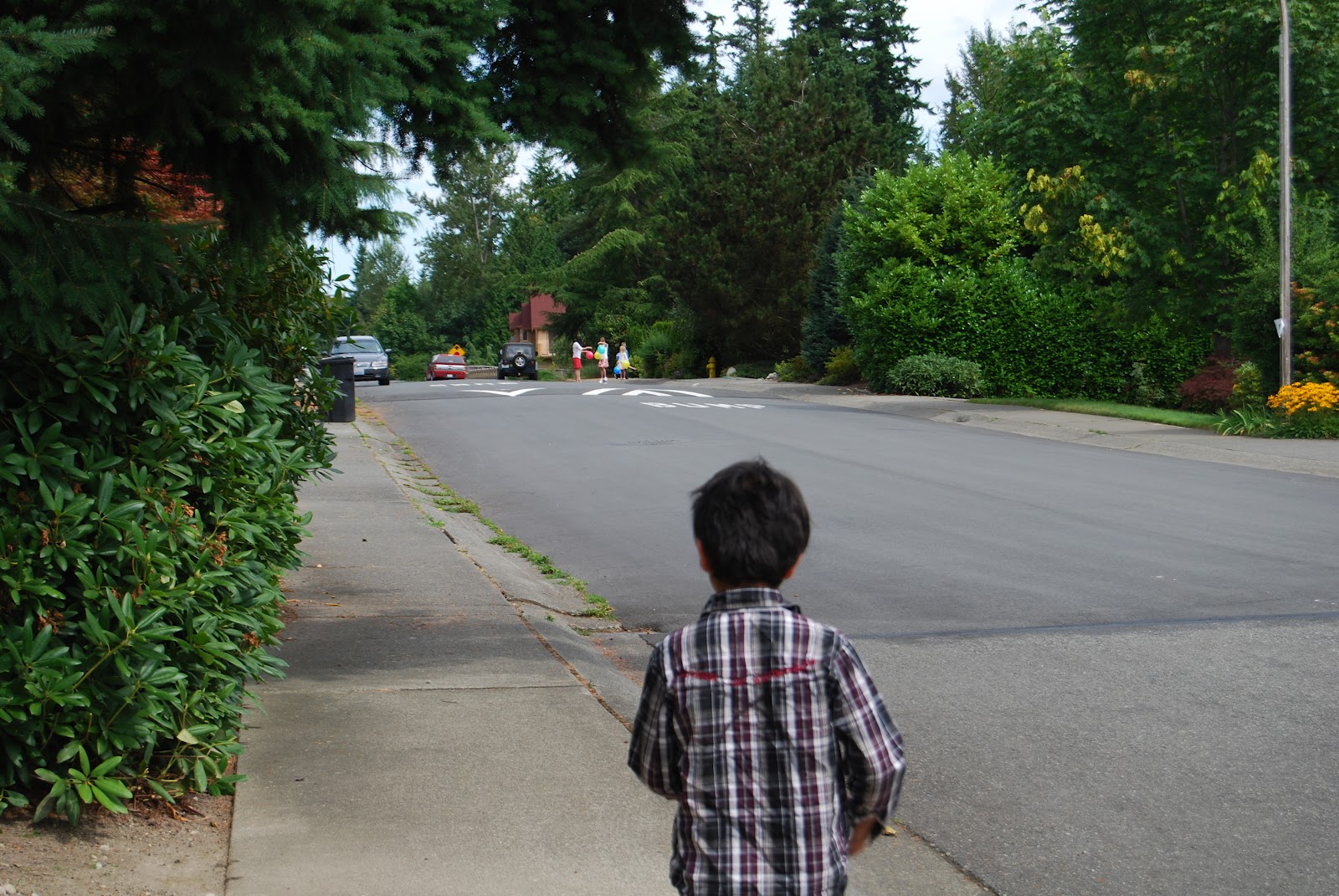
Afterwards we went in two groups to opposite ends of the street with cornstarch-filled balloons and popped them for each other in order to experience the difference between the speed of light and the speed of sound. It was fun! Because when we popped ours, there was a flash of powder and the explosion of the balloon, there was a couple of seconds silence... and then we could hear the other group suddenly say "Cool!!" in a chorus of exclamations- the sound of their reaction to the delay of sound of our popped balloon came a second late to our ears as well.

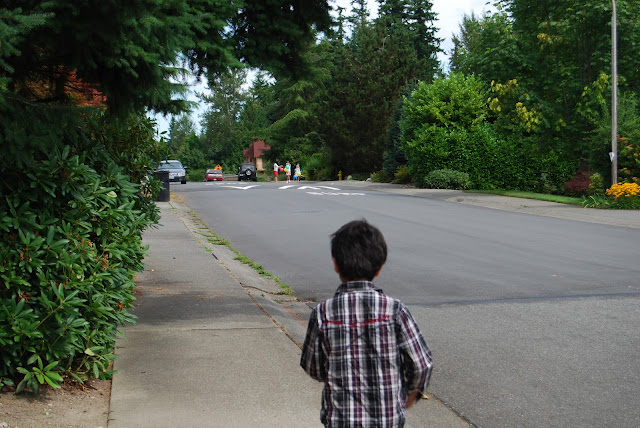 Unfortunately when I popped one of our balloons one of my children had taken the liberty of adding water. There was a lot of splattering! But that stuff is washable...

 Chris the Registered Piano Technician demonstrates Tuning techniques, Partials and Nodes
 The string is split into thirds...


Amber hears 440 Hz. with her own skull as a resonator!


Below: Eashan and Ashwin DETERMINED to get their balloons inflated! Even after that activity was concluded and everyone had moved on to the next activity, this pair sat on the couch huffing and puffing over their balloons. Finally I had to encourage them to move on before they became covered in saliva...


Stella was at the receiving end of quite a lot of comedy, however she could hold her own...

The following was a sweet reminder of the reasons I am happy I am a piano teacher: A little part of camp was the Violin Experience (These are all my violins) and everyone sounded pretty much awful... they were so enthusiastically scraping along and I was concerned things were going to get broken, including my ear drums. Stella alone made any reasonably musical sound come out of the violin because she had had some previous experience!

This was the location of the very successful piano recital! (We're pianists, after all.) Below is the program that was given. In the background you see one of the residents who was so pleased with the performance she started passing out dollar bills to the kids! Some of them said, "Wow, I never got paid for playing the piano before!" The rehearsal two days before proved that the program was going to be a success, and it was. The residents kept saying "bravo!" and the caretakers always stopped to watch, always smiling. There really was quite a display of virtuosity for such a young group!

Recital Program, August 9, 10:30 AM
Amber, 6
Spanish Caballero
Village Waltz (Kohler)
The Great Escape (Randall Hartsell)
Luke, 6
Spanish Caballero
Deep Singer
Eccosaise (Beethoven)
Eashan, 7
Sonatina in F Mvt. 1 (Clementi)
Gavotte in G minor (J. S. Bach)
La Chasse (Burgmuller)
Luke B, 8
Arabesque (Burgmuller)
Ballade (Burgmuller)
Tarentella (Burgmuller)
Ashwin 7
Trumpet Tune (Duncombe)
King William’s March (Jeremiah Clark)
Stella, 11 – Waltz in A minor (Chopin)
Jamin, 8 Jazz Sonatina (Robert Vandall)
Waltz in A minor, (Grieg)
Afterwards we went in two groups to opposite ends of the street with cornstarch-filled balloons and popped them for each other in order to experience the difference between the speed of light and the speed of sound. It was fun! Because when we popped ours, there was a flash of powder and the explosion of the balloon, there was a couple of seconds silence... and then we could hear the other group suddenly say "Cool!!" in a chorus of exclamations- the sound of their reaction to the delay of sound of our popped balloon came a second late to our ears as well.



Look at that node right in front of Luke's shirt! (above)
Chris demonstrated the tonal relationships of partials on the guitar while Luke tries to get the rope to whip up the right number of nodes for that particular pitch.

Amber hears 440 Hz. with her own skull as a resonator!

The biggest thing gained, I believe, besides a big introduction to physics of sound, was a very increased awareness of rhythm, because we daily played a rhythm game that was so addictive I suppose the kids would have played it the whole camp if I'd let them. I am going to have to describe it soon in another post, but I can now throw any sixteenth/eighth/quarter rhythm including rests and syncopations at these kids, and they are equal to it.
We watched part of a Beethoven Documentary which I thought was a little heavy duty in spots, but still awesome. The kids loved the way Haydn's face fell when Beethoven said "Every artist must find his own way.." "Oooohh..." they said, and we had to backtrack over that spot a few times. They knew exactly what was going on in the relationship between the two composers and they reveled in the tensions between them! I got a kick out of that.
Here is Luke age 8 doing some fantastic tricks that have nothing to do with music camp but were amazing enough to have to post anyway.


Sunday, December 18, 2011
Studio Winter Recital

Here is the group! These are most but not all of my students. 21 of these students in the picture have been studying with me for less than 18 months. I have heard a lot of progress this year!
I really enjoyed this year-end recital; We made sure that most students did not stretch to play their hardest pieces so they were very comfortable performing. I heard a lot of genuine musicality, phrasing, dynamics and real involvement in the music making experience, from all ages and levels. As the teacher I felt so comfortable and, well, thrilled at what was happening from the beginning. I'd already done a bad thing setting up that night by spilling an entire gallon of apple juice on the carpet- I felt like I was setting the tone for a bad night- but no way- it was awesome. The students really shone. I also really appreciated how well behaved the kids all were: they were supportive of each other, nobody was running around and playing pianos... At first the shop owner was really worried about the crowd we had coming- over 100 people! But they all behaved beautifully, and he was definitely happy: the parents were quickly cleaning up at the end- 10 minutes with several hard workers had all the chairs away, cookies cleaned up, everything back in order. (...Now if we could only get the piano teacher not to drop the apple juice jug!!)
Afterwards we enjoyed getting photos taken by a professional photographer ...as well as the obligatory cookie reception. What a great evening!
Saturday, December 10 2011, 6:00 Recital Program (Last names edited out for privacy)
Ella, 5
Lemonade Stand (Faber)
All My Friends (Faber)
Firefly (Faber)
Violet, 3
Frogs on Logs (Faber)
D-E-F March (Faber)
Marching (Dmitri Kabalevsky)
Sriya, 6
The Juggler (Faber)
“This is Not Jingle Bells” (Faber)
Sarah, 8
The Haunted Mouse (Faber)
The Grumpy Old Troll (Faber)
Ashwin, 6
Young Hunter (Faber)
Canoe Song (Faber)
Luke C, 7
Marching (Dmitri Kabalevsky)
Red Feather (W. E. Robinson)
Luke D, 6
Romantic Story (Gurlitt)
Luke B, 7
The Sleeping Dragon (Nancy Telfer)
Reflections and Swooping Blues (Paul Sheftel)
Livi, 9
Morning at Spring Meadow (Hartsell)
Sowmya, 9
Aria (Daniel Speer)
Gavotte (Handel)
Rowan, 8
Dance of the Irish (Faber)
Taylor, 10
Don’t Wanna Leave You Blues (Martha Meir)
Drew (13) and Taylor
Hush a Bye and Jamaica Farewell (Folk Tunes)
David, 10
Theme from New World Symphony, mvt. 2 (Dvorak)
Pumpkin Boogie (Faber)
Chloe, 6
Dance Song (Sperontes)
Grandfather’s Musical Clock (Rohde)
Amber, 6
Sonatina in G Major (Thomas Attwood)
Morning at Spring Meadow (Randall Hartsell)
Jackie, 7
Ballerina in a Chinese Garden (Composed by Jackie)
The Great Escape (Randall Hartsell)
Daniel, 9
Relay Race (Jon George)
Sonata in D minor K. 90d (Scarlatti)
Andrew, 12
Clowns (Dmitri Kabalevsky)
Arabesque (Burgmuller)
Eashan, 7
Musette (J. S. Bach)
Sonatina in G major, Mvt. 1 (Beethoven)
Jamin, 8
Jazz Sonatina,Mvt.1: Rhythmic (Robert Vandall)
Emily, 8
Recollections (Randall Hartsell)
Stella, 10
Invention No. 8 in F major (J. S. Bach)
Sonatina in F major mvt. 2: Rondo (Beethoven)
Haily, 12
Prelude No. 16 in D flat Major (Robert Vandall)
Katie, 16
Waltz in A minor (Edvard Grieg)
Lauren, 13
Fur Elise (Beethoven)
Dan, 17
Scherzo from Sonata in E flat Major (Beethoven)
Stefan, 15
Sonata in C minor Mvt. 1: Molto Allegro (Mozart)
Dawson, 17
Canon in D by Pachelbel (duet with Ms. Bonnie)
Improvisation
On a different note, we are preparing for another recital entirely, to happen next week... starring three of these students!
Monday, October 31, 2011
"Easy and Hard" - I want my kids to see it.
This little tiny movie is very beautiful and moving. Perlman and this little girl have a conversation about things easy and hard and the setting says it all.
Thursday, October 27, 2011
Practice-o'-Lantern

I'm the type of person that tries to find creative alternatives to standard procedures, especially when there is a point to be made. I carved this pumpkin with the perennial music teacher's one-word command, and set it beside the studio door. Though it garnered a lot of giggles, my students actually are practicing more, though I am sure it has more to do with upcoming performances and new pieces than with this pumpkin.
My studio grew!! I believe I am teaching no less then 40 hours of piano lessons every week now, even over 45 hours/week when my own children are practicing their full time daily. This hour a day and sometimes more with my own three children is really intense, but I am finding that consistency and playing practice games are really paying off. Oh, and getting enough sleep at night. Good night.
Monday, October 17, 2011
Boogie Boarding in December
WINTER: Snow is falling through the night on the studio roof, and the piano teacher crunches over the snow in warm, fur-lined boots and teaches for one hour. The piano student, a young man named Tae, is wearing shorts and a T shirt and is barefoot. But the piano teacher wastes no sympathy on the thinly clad student: she pulls her sweater closer and sips a hot drink and closes the piano lesson with these words:
"Have fun boogie boarding!"
"Have fun boogie boarding!"
And he does, too, directly after the lesson. He will not die of hypothermia because he lives on the beach and it's hot: it's a sunny afternoon in Australia and the way he leaves the studio is to turn off the computer.
 Tae was the top prizewinner in the Queensland Junior Eisteddfod for 2011 and won top prizes in many divisions of the regional piano competitions in the last few years. He also received a music scholarship from his school and is an avid tennis player, and a high achieving scholar.
Alexander Graham Bell would have flipped to see Webcam. Washington State and the Gold Coast all hooked up for music lessons! (Bell was a pianist too.) I began teaching Tae this way just over four years ago. In fact, it would have been about this time that his mother Helen Donaldson announced in my studio that they would be returning home to Australia and that was the end of our happy nine months of incredible piano progress together. They made the bog move, and as we stayed in touch we came across the idea that the lessons need not end. They had not started him on lessons because they had not found a suitable teacher, and I had been regretting the loss of such a promising student. We began very shortly after that, with meetings at our respective pianos with respective computers before us, sometimes at ridiculous hours of the night, sometimes not at all due to forgetting daylight saving doesn't exist in Australia (oops), sometimes with windstorms abruptly powering out the lessons or miserable rainy night connections obliterating the entire development section of a sonata, or sometimes having Windows Live screen suddenly freeze my face into one of those in-the-middle-of-a-blink faces that looks like I have a decimal point in front of my IQ, and equally frozen expression makes him look like he hasn't slept in fifty hours.
Most of the time it wasn't that eventful, but webcam lessons have more than enough disadvantages to make up for the lack of commute time! However, these lessons have allowed us to continue a very good student/teacher relationship, with the added advantage of Tae having come over for a week of lessons once in April of 2010, so I was able to see him in person, and also ran him through a gauntlet of performances, masterclasses, field trips and lessons. More recently he has had a lesson with a teacher from Belgium who was in Australia and was able to connect with them in person while there. Again, technology allows wonders!
We tried out Skype, Logitech, Windows Live and maybe some others, but windows live is the best for musical connections. After I'd hear Tae play, I'd give him suggesting, hear him work it out at the keys, and also have him carefully go through sections checking for notes because if you have someone who loves forgetting that accidentals carry through the measure (truly the only fault of this talent!) and you're working through an obscure, polyphonic and nearly atonal passage, working on the computer is a tremendous challenge.
Afterward, I would type an assignment either in a Word document or in the body of an email.
The following was a randomly chosen example of the type of follow up notes I would send after a lesson. He studied music theory with his mother and from books. (Teaching theory over the internet is very, very difficult!)
___________________________________________________________

Alexander Graham Bell would have flipped to see Webcam. Washington State and the Gold Coast all hooked up for music lessons! (Bell was a pianist too.) I began teaching Tae this way just over four years ago. In fact, it would have been about this time that his mother Helen Donaldson announced in my studio that they would be returning home to Australia and that was the end of our happy nine months of incredible piano progress together. They made the bog move, and as we stayed in touch we came across the idea that the lessons need not end. They had not started him on lessons because they had not found a suitable teacher, and I had been regretting the loss of such a promising student. We began very shortly after that, with meetings at our respective pianos with respective computers before us, sometimes at ridiculous hours of the night, sometimes not at all due to forgetting daylight saving doesn't exist in Australia (oops), sometimes with windstorms abruptly powering out the lessons or miserable rainy night connections obliterating the entire development section of a sonata, or sometimes having Windows Live screen suddenly freeze my face into one of those in-the-middle-of-a-blink faces that looks like I have a decimal point in front of my IQ, and equally frozen expression makes him look like he hasn't slept in fifty hours.
Most of the time it wasn't that eventful, but webcam lessons have more than enough disadvantages to make up for the lack of commute time! However, these lessons have allowed us to continue a very good student/teacher relationship, with the added advantage of Tae having come over for a week of lessons once in April of 2010, so I was able to see him in person, and also ran him through a gauntlet of performances, masterclasses, field trips and lessons. More recently he has had a lesson with a teacher from Belgium who was in Australia and was able to connect with them in person while there. Again, technology allows wonders!
We tried out Skype, Logitech, Windows Live and maybe some others, but windows live is the best for musical connections. After I'd hear Tae play, I'd give him suggesting, hear him work it out at the keys, and also have him carefully go through sections checking for notes because if you have someone who loves forgetting that accidentals carry through the measure (truly the only fault of this talent!) and you're working through an obscure, polyphonic and nearly atonal passage, working on the computer is a tremendous challenge.
Afterward, I would type an assignment either in a Word document or in the body of an email.
The following was a randomly chosen example of the type of follow up notes I would send after a lesson. He studied music theory with his mother and from books. (Teaching theory over the internet is very, very difficult!)
___________________________________________________________
October 23 2010
Technique work - Scales at 120 A flat, Bmajor this week, HT
coordination
J.S. Bach This week- bring to at least 120 to an eighth note
Voice the daylights out of your chords to get that brilliant
color
Brillance: flashes, constrasts, direction: peaks and valleys
Preludes are always accompanied by Fugues
Countersubject Repeated notes buildup intensity, following 16ths
release pressure
17 hear every note every clearly- Episode -take LH alone to
study fingering, notes
Bach is so good for
every musician: So solid, structured, so RIGHT. You just can’t fake Bach.
MM needed for structure. Put a goal to each section with the MM so it is
accurate. Your Fragments are ragged. Make sure they follow the subject in
parallel motion. Take care! There was a lot of “approximation”- it is more
exact. Learn notes like you’d learn surgery.
Knowing keys of subjects
Haydn
Pulse: set it up – stick with it
m. 23 rushes. Get control of pulse- put the heartbeat in
your fingers
39 LH seventh
Leif Ove Andsnes playing this: Pay special attention to his
skill in pedaling
Make this 100% clean 65-79
What is the character of Theme 2? Little bird trying to make
up his mind in a candy shop, maybe. Sweet and golden, with levels of sound and
sure 16th rhythm.
LH woodwinds piping up a slow incline
95 virtuosic
Rush Hour
Mozart
Schubert
Mendelssohn- I have to send it through still…
Thank you for taking
care to write in your music. This is so helpful. In my music I like to mark
peaks and echoes. You may find that helpful as I did.
______________________________________________________________
Though it is nearly shorthand, Tae is the kind of student who sees the meaning between all the lines, and rarely do I have to bring something to his attention more than once. He has an enormous repertory for a thirteen year old, and I am curious to find out the rest of his future story...
Sunday, July 31, 2011
A week without piano (Sort of)
Many of my students I missed last week. Well, we had an awesome vacation! Swimming in the Columbia river, playing Glow-in-the-dark tag and a 100 ft. long slip'n'slide, cabins, firelight sings, encouragement in the Holy Scriptures, bike jumps and loads of friends, unlimited Slurpees and great food... There was a horrendous piano at the lodge that had real ivory keys of all dirty shades of brown, several of which were either broken or completely missing, and original hammers that had to be at least 100 years old. (Probably the original tuning too!) We didn't practice much even if we had the time, inclination and the books! There is some point at which making your kids practice on something like that is a bit much. But one girl at camp spent five hours over two days playing the first three measures of Fur Elise over and over that another girl at camp had taught her. Wish I were kidding...
...Actually, I wish I were her teacher! :) With patience motivation and determination like that, she'd go really far!
Listening I enjoyed this week (on the road trip!): Pletnev Plays Bach-Busoni Chaconne
and here is where that Chaconne come from: it is a very famous Violin Solo piece from Bach's Violin Sonata in D minor, and Maxim Vengerov plays it- this is more a memorial than a concert.
Then after we came home late Friday, I taught six piano lessons yesterday, then we climbed to the top of Mount Si.
OK, I'll admit it: I never have any week without piano!
Friday, June 24, 2011
Wednesday, June 15, 2011
Foot Rests for Young Students
mypianofootrest.com has these foot rests that look very high quality. If your child is practicing with dangling feet, here is your answer!

Saturday, May 14, 2011
Pipe Organ Field Trip

Today many of the students in my studio went on a field trip to a large church that had a pipe organ with 2,996 pipes. The organist is always so accommodating to my studio, bringing extra pipes and instrument parts, explaining the workings of the monstrous instrument, describing the different-than-piano-technique needed to play the organ, and best of all, getting just the right sound for all the students' pieces. Today it was mostly my youngest students, and it was a really nice group. If you look carefully through the pictures, you can see the reactions of some of the youngsters when the organ reaches its loudest volume!


(Did anyone ever write a method called "Teaching Little Feet to Play?")


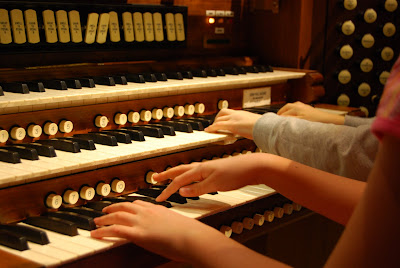


The children were kept fascinated not just by the playing, but also by the demonstrations.
Pictured above is the LaDonna, the organist who has been a wonderful guide to my students in their first introduction to the king of instruments!
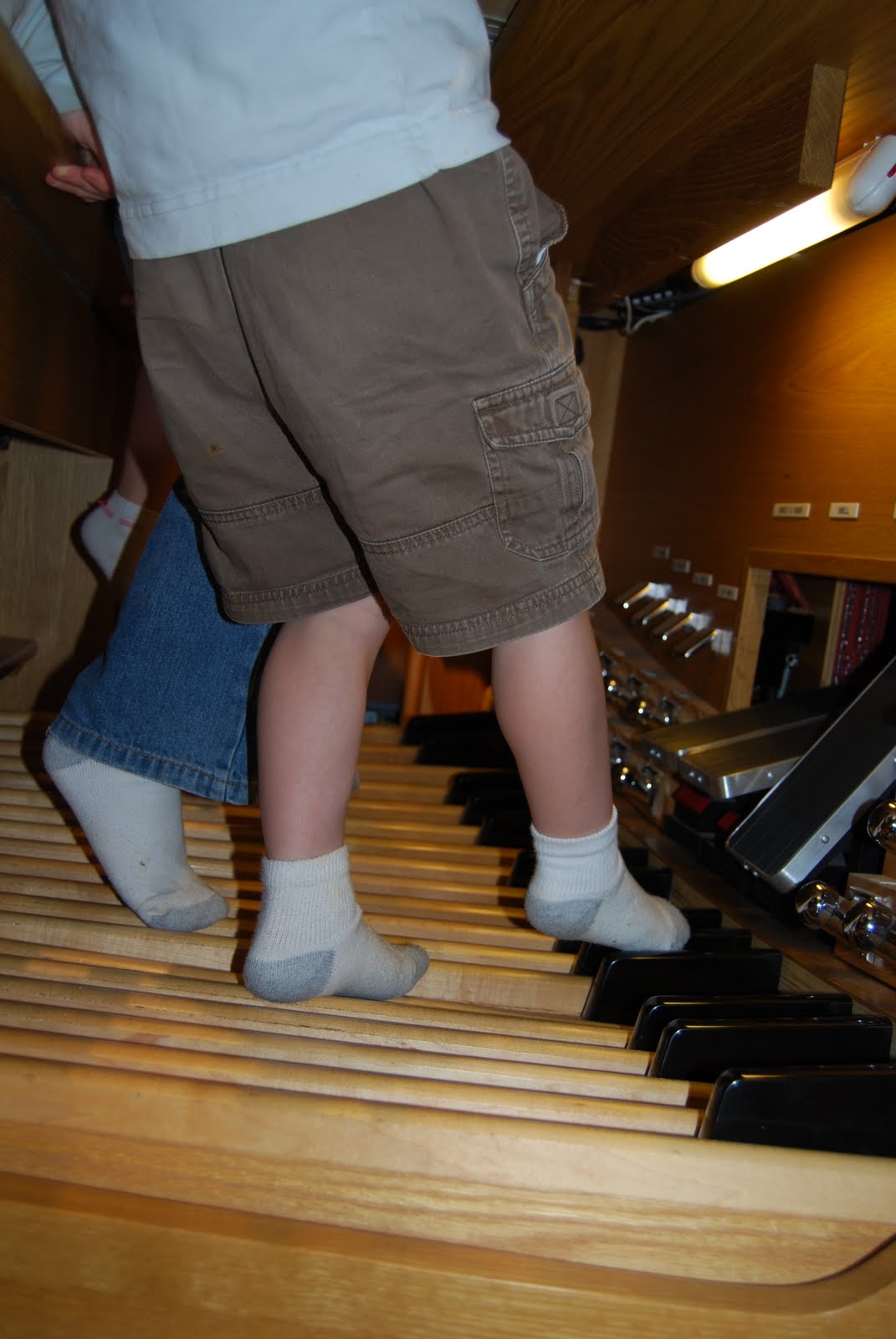

When you pull out all the stops for the lowest pedal pipes the whole room vibrates and it can get startlingly loud...

...inducing fits of giggles


(You gotta do what you gotta do!)

The "tubas" up top

Their duet turned out to be more suited to the organ than the piano!


There were more students who are not pictured playing, but sometimes I had to listen, too! This is the only instrument I have ever seen that has its own telephone. I should have given it its own picture, as well as the pile of little shoes that grew as more and more children performed! LaDonna, as well as the other listeners had many fine things to say about these young performers who adapted their considerable pianistic skills to the pipe organ this afternoon.
Thanks to all that participated!
Subscribe to:
Posts (Atom)